

Core
Schedules that follow the sun
Record the dawn chorus, dusk and night relative to local sunrise and sunset, with duty cycles and date ranges for long deployments.
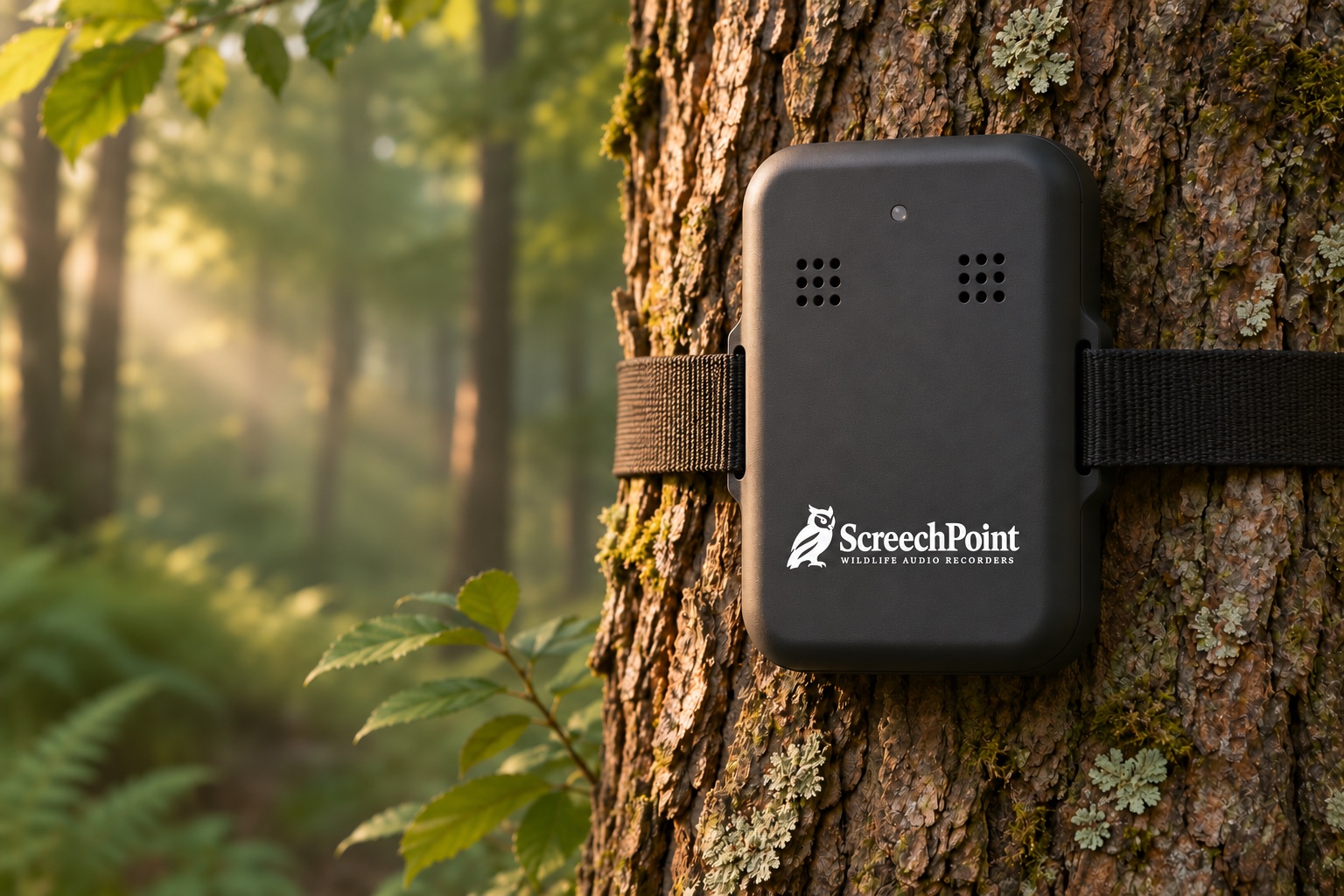
Wildlife audio recorders for research, conservation, and closer listening outdoors.
Strap it to a tree. Set a schedule. Come back to weeks of birds, frogs and night sounds.
Records when you planned, every day of the deployment.
WAV files kept on the card, nothing thrown away.
Designed for fewer battery runs and fewer site visits.
Sealed for rain, humidity and cold nights in the woods.
The recorder
Everything a field recorder needs to do on its own, plus the checks that tell you it’s working.
Record the dawn chorus, dusk and night relative to local sunrise and sunset, with duty cycles and date ranges for long deployments.
Every recording is saved as an uncompressed WAV file, with time, location and settings written inside.
Long battery life is a core design target. External and solar input is under evaluation.
A sealed enclosure for rain, humidity and cold nights, with a protected microphone port.
Standard files and predictable names that open straight into the tools you already use.
Build a schedule once, check the microphone and confirm it’s ready before you walk away.
Optional check-ins for battery, storage and microphone health.
Satellite time and position, so a grid of recorders shares one clock.
Full-spectrum recording for bat surveys, on the same enclosure.
How it works
Choose recording windows around sunrise and sunset, or set fixed times.
Run a microphone check and confirm the clock and location before you leave.
The recorder follows its schedule and writes every recording to the card.
Swap the card. Files are named by unit, date and time, ready for analysis.
What it listens for
Six groups of callers, from low hoots to calls above human hearing. Pick one to see what it looks like on a recording.
Spectrograms are illustrative drawings, not recordings from the device.
Who it’s for
From survey crews running dozens of units to a landowner curious about what calls at night.
For ecologists, survey teams and labs that need documentation and workflows they can rely on.
For land managers and conservation groups, often working with volunteers.
For naturalists and curious landowners who want an inviting way into wildlife recording.
Our approach
We’re asking researchers, consultants and land managers what their recorders are missing. These come up most.
Recorders can fail to start, fill a card or lose power, and nobody knows until retrieval day.
Sensitivity drops with age and weather. A 5 dB loss can shrink the area a recorder covers by about a quarter.
Every battery run is a drive, a hike and a day of someone’s time, and runtime claims rarely match the field.
Setting clocks, schedules and site names one recorder at a time eats the field day.
Condensation, worn seals and wet microphones end deployments early.
Renaming, missing metadata and drifting clocks slow down every project that follows.
Where it fits
Field recorders fall into two groups today. We’re aiming for commercial dependability with simpler setup and a price that works for many units on one site.
| Open-source boards | Commercial recorders | ScreechPoint · design goal | |
|---|---|---|---|
| Price per unit | About $80–100, plus a case | About $150 to $1,300 | Not set. Designed for many units per site |
| Recording | Uncompressed WAV | Uncompressed WAV, some lossless or compressed options | Uncompressed WAV |
| Enclosure | Bare board, waterproof case sold separately | IP67 housing | Sealed housing, rating published after pilot testing |
| Setup | Computer and USB, one unit at a time | Phone app, on-unit screen, or both | Phone app with saved configurations |
| Microphone health | Not built in | Built-in tester on the newest flagship | Self-test at setup and on a schedule |
| Remote status | None | Announced for one flagship, or contract systems | Optional check-ins (exploring) |
| Time and location | Set from the computer, GPS add-on board | Set by phone, built-in GPS on some models | Built-in GNSS (exploring) |
| External and solar power | Varies | On larger models | Evaluating |
Category summaries reflect publicly listed recorders as of November 2026, not any single product. ScreechPoint entries are design goals, not tested specifications.

Join the pilot
Tell us what slows you down and what your current equipment is missing. Pilot partners run prototypes alongside the recorders they already trust.
Field notes
Practical writing on choosing equipment, planning schedules and getting usable sound.
All field notesSample rates, microphones, power and enclosures, explained for a first survey.
ReadWhen to record, for how long, and how to stretch batteries and cards across a season.
ReadWhat you can and can’t capture at different sample rates, and when a bat recorder makes sense.
ReadQuestions